|
|
|
|
|
CLICK A TOPIC TO VIEW IT
HOME
A NEW LIFE BEGINS
VERY EARLY PREGNANCY
THE PILL AND OTHER FORMS
ABNORMAL MENSTRUATION
ENDOMETRIOSIS
FEMALE GROWTHS AND CANCER
GYNAECOLOGICAL
OPERATIONS
SONARS
PUBERTY
MENOPAUSE
PREGNANCY AND CHILD
BIRTH
GLOSSARY
How Does A Pregnancy
|
Do You Understand Your Body?Adhesions: What is it? Adhesions Explained!
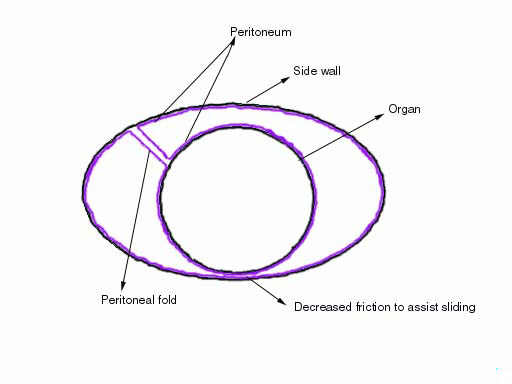
A DISCUSSION ABOUT ADHESIONS This page provides basic knowledge about adhesions and what cause them. Only adhesions occurring in the peritoneal cavity will be discussed. The female organs relate to the peritoneal cavity and only adhesions occurring in the peritoneal cavity effect them. Adhesions begin when tissues that should be separated grow together and adhere to each other. Adhesions are very common in the peritoneal cavity. It is important to have an idea about the peritoneal cavity in order to understand adhesions. We all know that our bodies are hollow inside and divided in two compartments. The upper body compartment contains the heart and lungs and is called the chest. Its scientific name is the thorax. The lower compartment contains the stomach, the intestines, liver, spleen and the internal female reproductive organs. (Uterus, fallopian tubes and ovaries). Thi s compartment is known as the tummy. Its scientific name is the abdomen. In our present discussion we are only interested in the lower cavity , the one containing the female organs. The stomach and intestines are in constant movement and should be able to glide over themselves, to glide over the side wall of the body and to glide over the other organs without any friction. In order to obtain organ movement without friction the side wall of the body and the organs are covered with a special layer or membrane known as the peritoneum. Fluid is present between the peritoneal layers and thus friction is decreased. The peritoneum is reflected from the side walls of the peritoneal cavity onto the organs. |It surround the organs and are then reflected back to side wall. The next drawing will explain it. Note the peritoneal fold that is formed as the peritoneum passes from the side wall onto the organ and than back from the organ onto the side wall.
The peritoneal folds that are formed allow nerves and blood vessels to reach the organs. All the intra peritoneal organs are attached to the side wall of the body by these folds. The next drawing illustrates how the nerves and blood vessels reach the intra peritoneal organs.
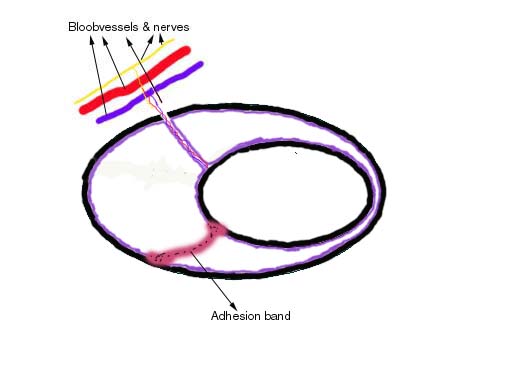
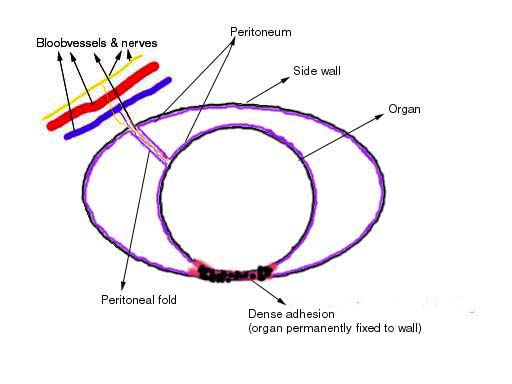
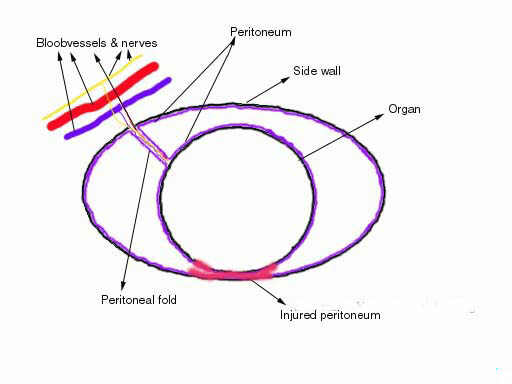 Injuries to the peritoneum (surgical cuts, infections (infections of the fallopian tubes included) and endometrial lesions) effect the layers of peritoneum . The layers become rough and sticky and where the two layers come intact, they stick together. This is explained in the next drawings.  Once the organ got stuck it either got stuck permanently or peritoneal layers stretch , the organ moves away but remains in contact with the site where the original injury occurred. The tissue that connects it to the site of the original lesion, is called an adhesion band. The next drawings illustrate this.
Visit the following page Photos to Illustrate Adhesions
Here is a video clip of an actual operation. The operation was done to treat severe adhesions. The video clip illustrates clearly what the medical term adhesion means,
If the clip fails to load on your computer, please CLICK HERE |
LAST UPDATE: 23 JANUARY 2004
|To go back click the browsers back button or click here to return to the home page.
Copyright FemaleHealthMadeEasy 2001- 2004
On Line Book Stores
All Under One Roof
Click to save on Magazines!
Amazon.co.uk Hot 100 Books
The asterisk ( * ) indicates your present position.