| |
FemaleHealthMadeSimple | |
Menopause, osteoporosis and hormonal replacement |
Do You Understand Your Body?Menopause: What is it? Menopause Explained!
A DISCUSSION ABOUT THE MENOPAUSE AND ITS EFFECTS This page provides basic knowledge about the menopause. Some aspects of the management of the menopauses are highly controversial. This page should only be used to provide information. It should never be used as a guide to self medication. Always contact your health care provider (doctor) before you change your medication or treatment. It is important to obtained as much information as possible to be able to make an informed consent about the management your or your loved one's menopause. Do not decide only on the information given on this page. This page should not be used as a treatment tool but only as one of many information tools. New evidence emerge since the first appearance of this page. Please refer to our August 2002 newsletter for more information. You can subscribe to the newsletter near the end of this page. We are in the process of rewriting this page. If we refer you to another page, most of the new pages will open in a new window. Just close the new window when you are finished and continue with this page.
The recent media reports regarding the safety of hormonal drugs during the menopause is
discussed in our recent newsletter. Subscribe for free at the bottom of the page.
Menopause occurs when both ovaries used up their egg cells. Egg cells are necessary for
the ovary to function and to produce the hormones estrogen and progesterone. The way in
which a normal ovary function is discussed
here.
Menopause also occurs when both ovaries are removed. This is sometimes necessary and women who
lost their ovaries have the same symptoms as women where the menopause occurs naturally.
Menopause occurs normally between the ages of 45 - 55 years. (with some differences
in different populations and in the reports of different researchers). This age is independent
of the number of children, the use hormonal contraception (The Pill) or other factors. All
women use up there egg cells at about the same age.
The pituitary gland still functions although the ovaries stopped functioning. The pituitary
gland continues to try and stimulate the non responding ovaries. The levels of FSH and LH
continue to increase in an effort to get to ovaries to respond.
See The Pituitary Gland
The lack of estrogen causes the symptoms experienced by post menopausal
women. The most common being hot flushes, dry vagina, tiredness, mood swings, night sweat and
disrupted sleep (insomnia) The incidence and severity of the symptoms differs from to woman to
woman.
There are also long term or late onset symptoms and complications, the most important being
increased incidence of heart disease , osteoporosis and a possible effect on the
onset of Alzheimer's disease. The long term effects will be discussed a bit later.
If the ovaries contains about 500 000 eggs at birth ,why are there no eggs left at
the age of 50 ? Although only one egg is released every month , it appears
that every day of a woman's life a few egg cells are ready to develop and if they
are not stimulated, they degenerate and disappear. For an egg cell to be stimulated and for
a follicle to start developing the hormonal conditions in the body must be perfect. Once
a month the FSH and LH ratio are conductive to follicle development and egg cell ripening .
During the rest of the month , before adolescence, while taking
oral contraceptives or during pregnancy the internal conditions are not perfect and
egg development won't occur. Degeneration of the eggs that are ready still continues.
That's why it doesn't matter how many pregnancies a women had or for how long she took
oral contraceptives, the menopause will still occur at the age of 50 . The time of the her first
period also have no influence on her age when the menopause occurs.
|
|
The first drawing illustrates the endometrium during a normal menopause .
The next drawing shows a post menopausal ovary.
Hormonal Replacement Therapy (HRT) During the Menopause.
Read our recent newsletter for more information and a discussion about the recent
media reports concerning HRT.
What is meant by hormonal replacement therapy (HRT)? It is the artificial replacement of
the hormone estrogen . This replacement can be taken in different forms. It can be taken orally
(tablets). It is also possible to administer it through the skin (via patches that stick to the
skin or ointments applied to the skin). It can also be injected or implanted underneath the
skin. The abbreviation HRT is used on this page and refers to hormonal replacement therapy.
Should a post menopausal woman use HRT? This is presently a controversial subject. Each individual
should decide for herself, but she should be able to make an informed decision. We will discuss
the advantages and disadvantages and also refer you to other sites in order to help you to make
a decision.
You will see that there are risks both ways. There are certain risks when not taking HRT and
other risks when taking hormonal replacement.
Advantages of HRT
1 Preventing Osteoporosis
2 Preventing Ischemic Heart Disease.
Ischemic heart disease and coronary artery thrombosis is rare in pre menopausal (before the
menopause) women. Following the menopause there is a sharp increase in the incidence of
these deceases . There is strong evidence that the use of HRT helps to keep the
incidence of ischemic heart diseases low at the pre menopausal level. It also seems that
HRT must be started early, at the onset of the menopause , to be effective. It is to late
and will probably have no beneficial effect if the coronary arteries are already effected and
sick. Than there is a even an increased risk of thrombosis. The coronary arteries are the arteries that
supply blood to the heart muscle.
About four times more women die from heart attacks after the menopause than from breast
cancer. It is still to early to say if HRT will decreased the incidence of heart attacks. At this stage ( early 2002) it appears that if a women with a healthy heart at menopause start using
HRT it will reduce her risk of ischemic heart disease. If however her heart is already effected or if she starts HRT after a heart attack it will not reduce her risk of further heart attacks.
This is presently a highly controversial subject. Many of the latest research cast doubt on the effectiveness
of HRT in preventing heart attacks and strokes. Some criticism against studies showing an increase in heart attacks
and strokes, is that there is doubt about the age at which the HRT commence. Was there already blood vessel damage
when HRT was started?
Please refer to our August 2002 Newsletter and get the latest information.
We know if the experts are in doubt and not in complete agreement , how unsure must a lay person feel.
Research is continuing and we hope to be able to have a clear answer in the near future.
There is more and more evidence indicating that HRT delay or postpone the onset of Alzheimer's
disease. This is also not proven beyond doubt and more research are required.
3 Possible decrease in the Risk of Developing Colon Cancer.
There are indications ( but no proof) that the use of HRT might decrease the incidence of
colon cancer. More and more data are available that supports this claim.
4 Relief of the menopausal and post menopausal symptoms.
Hot flushes, dryness of the vagina, painful sexual intercourse,
emotional disturbances ( difficulty controlling emotions), insomnia and dry skin are some of the common symptoms.
HRT effectively reliefs all these symptoms.
Disadvantages of HRT
1 Effects on the Breast.
HRT and its effects on the breasts are presently a widely debated and discussed controversial
topic. The main issue is
If all the presently available knowledge and research data are analyzed we think that the following discussion accurately reflects and summarizes
our present situation:
A. HRT probably does not change a normal cell into a cancer cell.
B. HRT will stimulate cancer cells that are already present to grow quicker. It accelerates breast cancer growth. Many researchers believe cancer is a slow disease at its onset and that
it may take up to eight years for a cancerous breast lump to become palpable. WHEN THE LUMP IS DISCOVERED THE ABNORMALITY IS PROBABLY PRESENT FOR SEVERAL YEARS.
C This stimulating effect on cancer cells could create an impression that the
incidence of breast cancer is slightly increased in women on HRT.
D. Women on HRT usually go for annual checkups and mammography. Cancer are therefore
diagnosed early and this can also create an impression of a higher incidence of cancer.
E. Breast cancer is usually diagnosed earlier in on women on HRT than in women not taking
any hormonal supplements.
F. The prognosis of women developing breast cancer while taking HRT is better than those who are develop it without taking HRT.
The points mentioned above are just impressions and not absolute facts. Thus is a controversial
issue. Controlled research into the matter is complicated because the people most likely to use HRT are also the ones more likely to go for regular check ups and are most likely more health conscience. To get proper answers in any research project you need control groups with life styles as near as possible to the group that are being tested. The women on HRT and the control group not using HRT must be properly matched to get a reliable answer.
Another complicating factor is the fact that the risk of breast cancer increases with age. The age of onset of menopause might also play role ( the effects of the normal production of estrogen during the fertile life). The previous use of oral contraceptives is another factor to take into account. There are also other substances with estrogenic effects present in nature
( in plants). An example is soy sauce which have an estrogenic effect tissue.
The intake of these substances might also influence the development of breast cancer.
( It is believed that some of them do not have estrogenic effects on the breasts and might
have a protective effect against breast cancer)( see SERMS a bit later.)
The present controversies are probably due to (at least in part) to the factors discussed above.
On fact is however clear from our present knowledge and that is if HRT usage increases the risk
of breast cancer, than it is only a small increase in the risk. The risk is very small during the first
ten years of HRT usage.
2 Effects on Blood Clotting.
HRT usage increase the risk of intravascular coagulation, the formation of blood clots in
the veins , especially the veins of the lower limbs ( legs) There is also an increase risk of strokes
( clots in the brains blood vessels.
This risk is increased in smokers, persons with a history of previous blood clots and in people who are physically
less active.(physical activity keeps blood circulating and helps to prevent blood from clotting in the blood vessels.
Women taking HRT should always inform their surgeons and anesthetist about it before undergoing operations.
In a healthy non smoking women with a normal or low blood pressure it is doubtful of the risk is of any significance.
The final decision rest with you. Carefully weigh the evidence and the risks. It is also important to consult
your doctor. The following paragraphs will just give an overview of present thinking. Since this site was
compiled new evidence emerged and we are in the process of rewriting this page. This will be an ongoing
process a new data keeps on emerging. Please refer to our August 2002
newsletter for more information.
Presently:
If a
women has uterus than progesterone should be added to the supplement. ( either continuously or at least for ten days during
each cycle). The continuous use of progesterone is now doubtful due to new evidence. Until there is more clear
evidence we advise that the continuous use of progesterone ( taking a progesterone containing tablet every day)
should be stopped . Refer to our August 2002 newsletter for more information
Following a five year periods:
Hormones influences our bodies via areas on the walls of our cells known as receptors. The hormone binds or react
with these receptors and causes some chemical changes in the cell. The hormone will only effect cells with receptors
that will accept and react with it.
There are two kinds of estrogen receptors. The one kind is present in the uterus, vagina, bladder and the breast.
The other kind is present in the rest of the body like bone tissue. A drug that stimulates only the receptors
in other parts of the body and not the breasts, uterus, vagina and bladder is known as a SERM.
A SERM will have some of the advantages , heart attacks and probably postpone the onset of osteoporosis A disadvantage
is that
hot flushes , dry vagina and other symptoms may recur. This is one of the reasons why SERM are usually only prescribed later
yin post menopausal life.
One last comment . All medicines have their origin in natural products. They are either purified extracts of plant or
animal material, or modified copies of natural occurring substances. Therefor if so called "natural products" are effective
they should have the same side effects. The only difference will be that they are less purified (?more natural) and therefor
less potent .
We will now discuss the basic facts of osteoporosis.
Osteoporosis is a bone disease that causes bone to become fragile and brittle. This
causes bone to fracture easily. There are many causes of osteoporosis , but on this
page we are only concerned about the menopause.
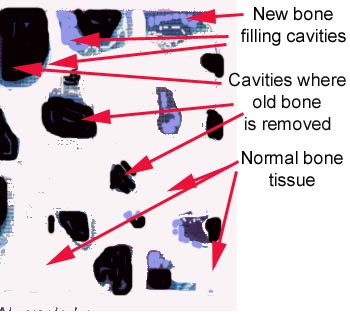
Our bodies are constantly changing. Old tissue are destroyed and replaced by new
tissue. This also occurs in living bone. Cells called osteoclasts constantly eats
away old bone, creating tiny cavities in bone tissue. Another kind of cells , known
as osteoblasts constantly forms new bone tissue and fills up these cavities. The net
result is that bone loss and bone formation occurs at the same rate in the adult human.
There is an equilibrium between bone reabsorption and bone formation.
The hormone estrogen is one the substances responsible for the formation of new bone tissue.
The lack of estrogen after menopause slows down the formation of new bone, the cavities in
the bone enlarged and the bone becomes brittle. The vertebrae , the neck of the thigh bone
and the wrist ( actually the lower part of the radius) is most commonly effected.
A GRAPHIC PRESENTATION OF OSTEOPEROSIS
The next drawing illustrates normal healthy bone tissue as seen through a microscope.
The cavities a small.
The next drawing illustrates the lack of new bone formation, causing the cavities to become
very large. The is a marked decrease in bone tissue. This is osteoporosis.
The next drawing illustrates a part of the spine. Four vertebrae and three discs are
shown.
The next drawing illustrates a decrease in bone mass in the vertebrae. The beginning of
osteoporosis.
The next drawing illustrates a compressed fracture of one of the vertebrae. This is
why it is important to try and prevent the development of osteoporosis.
Further reading:
|
|
|
We have an anti SPAM and privacy policy.
Your e-mail address will remain confidential
Webmasters : In need of extra traffic. Click here.
On the next page pregnancy and childbirth and problems relating to pregnancy will be discussed. .
Books to read.


END OF PAGE THE MENOPAUSE MADE SIMPLE
Copyright FemaleHealthMadeSimple 2001