| |
FemaleHealthMadeSimple | |
FEMALE ORGAN PROLAPSE PAGE
CLICK A TOPIC
WOMEN'S HEALTH HOME A NEW LIFE BEGINS
VERY EARLY PREGNANCY THE PILL AND OTHER FORMS
|
Prolapse of the Uterus, Vagina, Bladder and Rectum What is meant by prolapse?
Understand prolapse
ALL YOU NEED TO KNOW ABOUT PROLAPSE
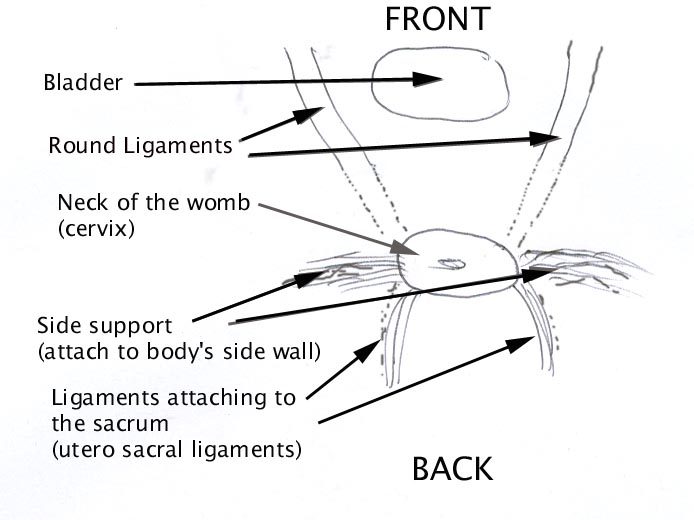
This page will provide a basic simple explanation of female organ prolapse. The information provided should not be use to diagnose nor be used to treat prolapse. It will just provide basic information to help you to understand the condition. If you visited the the first few pages of this site , you should be familiar with the basic structure of the female organs. Prolapse occurs when gravity pulls the womb, bladder and the lower part of the bowel (rectum) down through the vagina. The organs are kept in place and prolapse are prevented by structures known as ligaments. Ligaments are thickenings of connective tissues and give strength and support to tissues. These ligaments attach the female organs to the spine and pelvic bones. Thus support prevents prolapse ( support the organs against gravity).
We will use drawings which a practicing gynecologist is using to explain these support systems in a simple
manner. The drawings will also explain what happens when the support system is compromised, leading to
prolapse.
|
|
|
The first drawing show the female organs as seen from the front. The lower part of the womb (uterus) and the upper
part of the neck (cervix) are attached to the side wall of the body via ligaments.
The next drawing shows the womb (uterus) as seen from the side. It also shows the bladder in front and the bowel ( rectum part of the large bowel) at the back. The upper part of the uterus is attached to the pelvic bone via the round ligament. There are two round ligaments. They are attached to upper part of womb ( one on either side of the womb) and reach forward to connect the womb to the front part of the body. (one on either side of the bladder) The lower part of the womb and the neck are attached to the spine
The support systems will recover after birth but in some women only partially. Another factor influencing the support ligaments is advancing age. The ligaments deteriorate and become weaker with advancing age. Thus the main main reasons for the development of prolapse are pregnancies and childbirth( the more children the higher the possibility of prolapse) and age ( the older a women the higher the possibility of prolapse) An interesting unresolved controversial question is : DOES CAESARIAN SECTION BIRTH DECREASE THE LIKELYHOOD OF PROLAPSE?
The following drawings illustrates what happens to the female organs during prolapse. They will illustrate how the womb, upper part of the vagina, bladder and rectum ( the lower part of the bowel) are pulled down as the support systems weaken.
The above drawing illustrates early prolapse as seen from the front. Note how the vagina fold on itself as the womb drags it down and the weakened ligaments are stretched.
The drawing above illustrates severe advance prolapse. As the vagina and womb prolapse the bladder and rectum ( lower part of the bowel) are also pulled down. Click here for further illustrations: CLICK The usual symptoms are : 1 A funny feeling in the vagina or a feeling as if something is pushing down the vagina. 2 Loss of bladder control especially when sneezing, coughing or doing physical exercises. 3 Actually feeling the prolapse organs in the vaginal opening and being able to push it back into the vagina. The only effective treatment is surgical repair . The effectiveness of the different operations (vaginal hysterectomy, anterior and posterior repairs ) improved over the past two decades The development of artificial materials to enhance the support systems greatly improve the success of surgical treatment.
|
Last Update : 26 August 2003
Copyright Female Health Made Simple
Go to our
HomePage